Quick Answer
Digital safety tools pay for themselves by protecting margin where construction actually loses money: rework, disputes, and undocumented scope gaps. Solid, searchable documentation—photos, timestamps, signatures, certifications, and audit trails—helps contractors resolve issues quickly or avoid them entirely. Industry studies show rework commonly consumes 4–10% of project cost and can be higher, while dispute values remain historically high across regions. Preventing even a fraction of that waste with better documentation yields immediate ROI.
Introduction: Profit protection starts with proof
Every contractor has a story about a disputed charge that should have gone their way if only the paperwork lined up. On busy jobs, paper gets lost, photos live on personal phones, and certifications sit in a metal file cabinet. Digital safety tools fix the weakest link in that chain: proof. When your crew can capture conditions and completions in real time, then retrieve them in minutes, you reduce rework, resolve disagreements faster, and keep more margin on the job.
What is a back-charge in construction?
A back-charge is a cost a contractor deducts or assesses to recover expenses caused by another party’s incomplete, defective, or delayed work. Typical back-charges include labor to fix deficiencies, materials to replace damaged items, equipment standby, or cleanup. According to Procore, back-charges are often used in practice to function as a contractual set-off tied to performance.
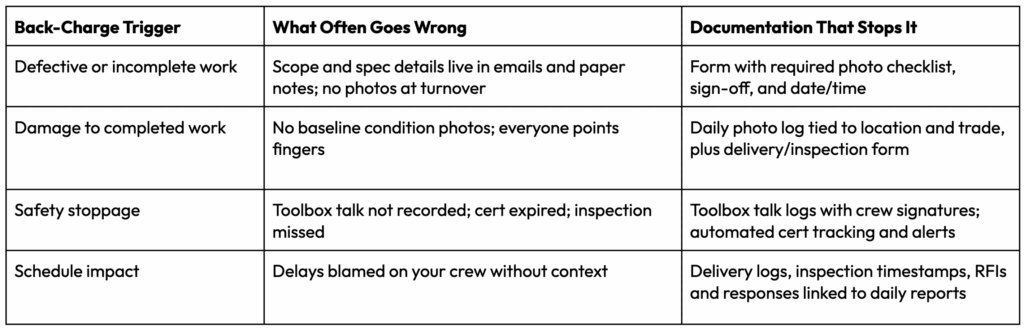
Common triggers
- Work not performed to specification or code
- Damage to completed work or materials
- Schedule impacts caused by late or unsafe work
- Safety violations that halt progress
Back-charges escalate when documentation is thin. If the record is incomplete (for instance, no photos, no signatures, no time-stamped form) the party seeking recovery faces an uphill battle.
The real cost drivers: rework and disputes
Back-charges sit inside a larger cost picture: rework and disputes.
- Rework: Decades of research show rework regularly consumes several percent of project cost. The Construction Industry Institute reports rework commonly ranges from 2% to 20% depending on project type and controls, with many studies clustering around 4–10%. Even small percentages on multimillion-dollar jobs translate to significant dollars.
- Disputes: Major consultancies tracking dispute trends report persistently high values and lengthy resolution times. Arcadis (2023) notes North American dispute values increased from 2021 to 2022 by 42%, remaining historically elevated. HKA’s CRUX program, analyzing thousands of projects globally, reports substantial sums in dispute and material schedule impacts. Even when your disputes are smaller and project-level, the macro trend is clear: disagreement is costly and time-consuming.
Back-charges are often the front line of those costs. Tight documentation reduces rework exposure and makes dispute resolution faster and cheaper.
Why paper trails fail on active jobs
- Fragmented capture: Photos on phones, forms on clipboards, certifications in binders.
- Slow retrieval: Finding a daily log or toolbox talk can take 30+ minutes, usually in the evening when decisions should already be made.
- Gaps under pressure: Busy foremen skip signatures, misplace pre-task plans, or forget to attach photos.
- Audit anxiety: Without a system, teams over-collect or under-collect, and both extremes make retrieval harder.
The result is familiar: the team “did the right thing” but cannot prove it fast enough to prevent a charge or win a dispute.
How digital safety tools change the outcome
1) Instant proof of conditions and completions
Field users capture photos and video inside the form with time, date, user, and location recorded automatically. Signatures and comments live with the same record. That single source of truth reduces ambiguity about who did what and when.
2) Centralized access for the office and field
Supervisors, PMs, and compliance leads can pull the exact form, checklist, or daily log in seconds. Retrieval speed matters during live disagreements, at progress draws, and during audits.
3) Automatic audit trails
Edits are tracked. Attachments are versioned. Certifications referenced by the form link back to the worker’s profile, so you can show training was valid on the date of work.
4) Proactive alerts that prevent violations
Notifications flag expiring certifications and missing inspections before they become stoppages or chargeable defects. Stoppages and remedial work drive back-charges; prevention drives ROI.
5) Consistency across crews and sites
Standardized templates for JSAs, pre-task plans, incident reports, equipment checks, and toolbox talks ensure consistency. Digital guardrails, such as required fields, photo prompts, or signature checks, help crews complete forms correctly the first time.
Quantifying ROI: conservative math you can defend
You do not need aggressive assumptions for a strong business case. Use prevented loss and time saved. Here’s a simple model:
- Project size: $5,000,000
- Rework baseline: assume 4% (conservative within the research range) → $200,000 potential rework exposure.
- If digital documentation reduces only 15% of that exposure via fewer defects, faster issue resolution, and better proof, that preserves $30,000 on one project.
- Add labor savings: if supers and coordinators save 20 minutes per day on document retrieval and follow-up across 5 key roles over a 180-day project, that is 300 hours. At $60 fully burdened, that is $18,000 reclaimed for management tasks that move the schedule.
Illustrative outcome: $30,000 (avoided rework/charges) + $18,000 (time return) = $48,000 preserved value on a single job, excluding soft benefits like faster closeout or insurance impacts.
These are directional numbers that align with research showing measurable cost reductions from digitization. McKinsey’s analyses attribute 4–6% cost reductions and 14–15% productivity gains to digital transformation in E&C when broadly executed. Your firm does not need the full upside for the math to work on everyday projects.
An anonymized field example
A mid-size civil subcontractor working across Ontario and New York standardized pre-task plans, daily reports, and photo documentation across four crews. Within six months, they:
- Dismissed two small back-charges related to alleged site damage using photo timestamps tied to daily logs.
- Resolved a schedule-impact dispute in two days by producing inspection and delivery records from the same week.
- Cut average “document hunt time” from 25 minutes to under 5 for PMs during payment meetings.
These are typical wins when teams capture and retrieve evidence quickly. While results vary, the mechanism is consistent: better proof equals fewer losses.
Where back-charges start, and the documentation that stops them
Disputes are getting more expensive
Market-level research shows higher dispute values and protracted timelines in many regions. Arcadis reported a 42% year-over-year increase in North American dispute values from 2021 to 2022. HKA’s CRUX Insight report (2024) shows that project disputes cost about ⅓ of overall spend, and lead to time overruns of ⅔ of a typical schedule. Even if your firm’s disputes are smaller and local, the macro signal is the same: better evidence pays.
Beyond back-charges: second-order ROI
- Prequalification strength: Organized safety records and training histories strengthen bids.
- Insurance conversations: Demonstrable safety management and fewer incidents can support better terms over time.
- Closeout speed: Digital turnover packages reduce mop-up work at project end.
- Culture: Crews understand expectations and can show good work. That helps retention.
A practical 30-day rollout for digital safety tools
Week 1: Pick the hotspots
Start with forms tied to common disputes: pre-task plans, daily reports, photo logs, equipment inspections, delivery/inspection receipts.
Week 2: Build standard templates
Make required fields obvious. Prompt for photos at the right steps. Add signature checkpoints. Map each form to a retrieval tag (project, area, trade, task).
Week 3: Train the supervisors
Simple, repeatable workflows win. Emphasize “document as you go” and show the two-minute retrieval drill for PMs.
Week 4: Review and tune
Pull three recent disputes or near-misses. Ask, “Could our current templates have resolved this faster?” Update templates and alerts accordingly.
Quick Recap
- Back-charges are recoveries for incomplete, defective, delayed, or unsafe work. Documentation decides outcomes.
- Rework consumes meaningful project value; 4–10% is a practical planning range across many projects. Preventing a fraction of that with better proof creates immediate ROI.
- Dispute values remain historically high in many regions, so faster, clearer resolution matters financially.
- Digital safety tools centralize evidence and make retrieval instant. That protects margin on everyday jobs.
FAQs
What is a back-charge in construction?
A cost assessed to recover expenses caused by another party’s incomplete, defective, or delayed work; often handled as a contractual set-off.
How does documentation prevent back-charges?
Time-stamped forms, photos, signatures, delivery and inspection logs establish conditions and responsibilities. Clear proof narrows disputes and can dismiss improper charges.
What portion of project cost can rework consume?
Studies and industry guidance commonly cite several percent of project cost, with many projects clustering around 4–10% depending on controls and project type.
Is there broader ROI from digitization beyond disputes?
Yes. Major analyses attribute productivity gains and cost reductions to digital adoption across E&C, in addition to fewer disputes and faster closeouts.