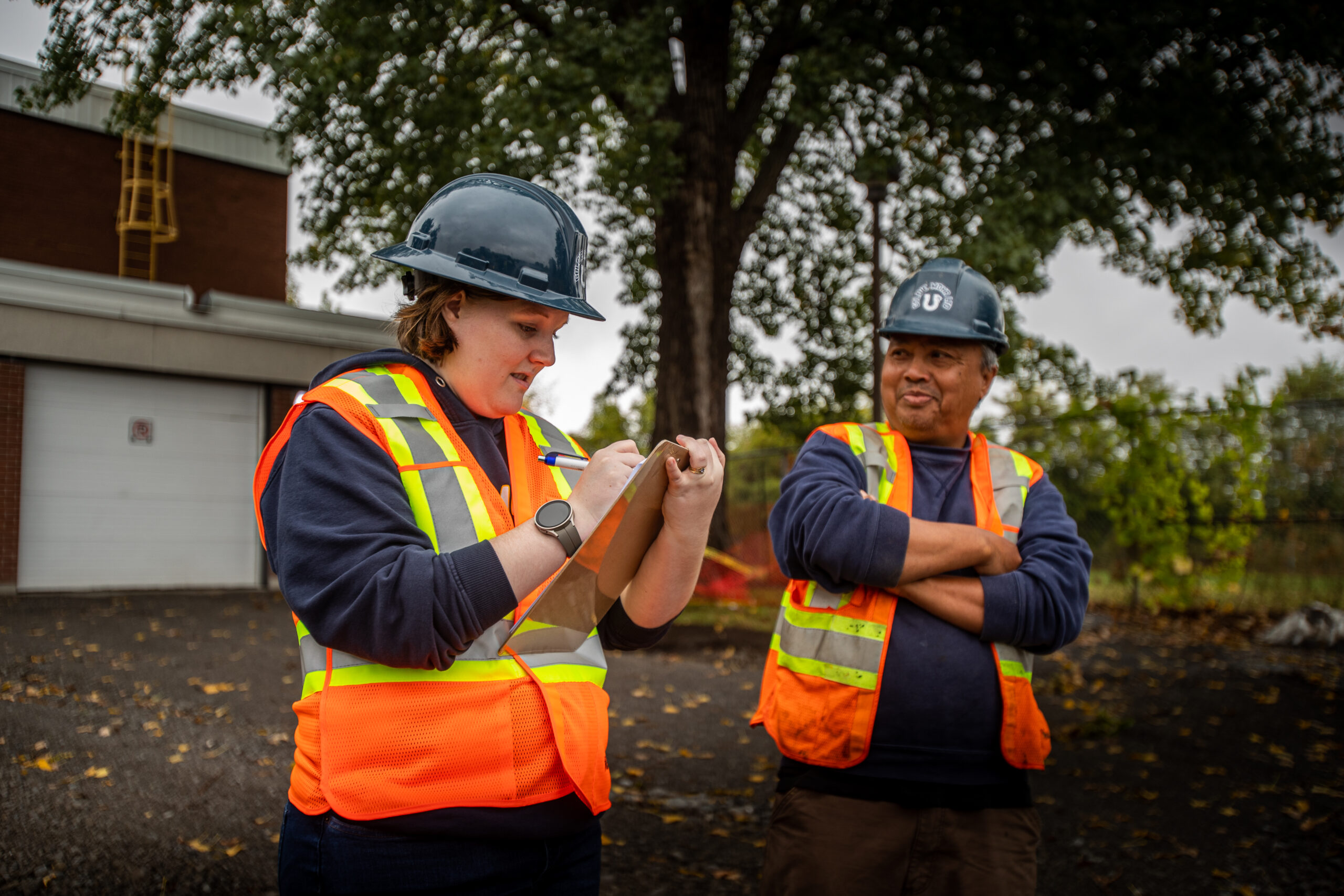
Corfix vs. Pen and Paper
Corfix is a construction safety and worker enablement platform that replaces paper safety forms, inspections, certifications, and timesheets with one digital system.
Pen and paper costs nothing to start and nothing to learn, which is why most construction companies begin there. The cost shows up later: forms that go missing after an incident, records nobody can produce fast enough for an audit, and hours of admin work re-entering the same information by hand. Corfix captures that same information once, on site, and keeps it retrievable when a regulator, insurer, or lawyer asks for it.
Why do so many construction companies still run on paper?
Paper has no cost, no login, and no learning curve
A clipboard costs nothing, requires no login, and never has a dead battery. For a small crew running one job at a time, a binder of forms and a foreman who knows every worker by name is a perfectly functional safety program. There’s no software to buy, no app to teach a fifty-five-year-old superintendent who’s never needed one, and no dependency on cell signal at a rural site.
That’s the honest case for paper, and it holds right up until a company starts running more than one crew, more than one job, or gets asked to prove something happened. At that point the same simplicity that made paper easy becomes the reason nobody can find what they need.
What breaks down once a company scales past one crew?
Certification expiry is the most common gap
A single foreman with a binder can track everything in his head. Multiply that by five crews across three jobsites and the informal system stops being informal, it becomes a liability. Each foreman fills out forms his own way. Some get filed. Some sit in a truck door pocket for two weeks. Certifications expire and nobody notices until a worker is on site without one. The office finds out about a near miss on Friday when the form finally makes it back, three days after it happened.
None of this is a failure of any one person. It’s what happens when a paper process that worked for ten employees gets asked to work for a hundred and fifty spread across multiple sites. The process didn’t get worse. It just stopped matching the size of the company running it.
What does an audit look like with paper records versus digital ones?
OSHA requires five years of retention, and paper makes retrieval the hard part
In the US, OSHA requires employers to keep injury and illness records, including Form 300, Form 300A, and Form 301, for five years after the calendar year they cover, and a completed 301 incident report is due within seven days of a recordable injury. Keeping those records on paper is legal. Separately, OSHA also requires certain employers to electronically submit data through its Injury Tracking Application: establishments with 250 or more employees in industries required to routinely keep records, and establishments with 20 to 249 employees in designated higher-hazard industries, must submit Form 300A data electronically each year, and some higher-hazard establishments with 100 or more employees must submit Forms 300, 300A, and 301 electronically. Construction is generally treated as a higher-hazard industry, so a meaningful share of mid-size and larger contractors fall into one of those submission tiers rather than the exempt group. In Canada, provincial workers’ compensation boards and COR auditors have their own documentation and retention expectations, and a COR audit specifically requires producing a consistent paper trail across every jobsite, not just the one being inspected that day.
With paper, meeting either of those obligations means someone physically locating the right form, in the right binder, from the right jobsite, from a specific week, and confirming it’s complete and legible. With Corfix, every form submitted on site is timestamped, tied to a worker and a project, and searchable the moment it’s needed. An auditor asking for six months of inspection records gets a filtered export instead of a phone call to every site office asking someone to go dig through a filing cabinet.
What happens the first time a form goes missing?
The gap surfaces only after something has already gone wrong
It usually happens after something has already gone wrong. A worker gets hurt, and the incident report that’s supposed to document what happened either wasn’t filled out completely, was filled out by hand in writing nobody can read, or was filled out and then never made it off the site. Now the company is trying to reconstruct what happened from memory, days or weeks later, for a report that’s supposed to hold up to a regulator or an insurer.
This is the scenario paper handles worst, because paper has no way to flag that something is missing until someone goes looking for it. A digital form either gets submitted or it doesn’t, and a supervisor can see in real time which workers haven’t completed theirs. The gap gets caught the same day, not the day it’s needed for a claim.
What Corfix does that paper can’t
Every core capability below is something paper structurally cannot do
Paper isn’t missing these capabilities because a vendor hasn’t built them into a clipboard. It’s missing them because searching, flagging, and auto-tracking are software functions, and a binder isn’t software. The table below lists each one directly.
| Capability |
Corfix |
Pen and Paper |
| Search records by worker, project, or date |
✓ |
X |
| Flag a missing or incomplete form the same day |
✓ |
X |
| Track certification and training expiry automatically |
✓ |
X |
| Require a complete, legible form before it can be submitted | ✓ | X |
| Run the same process across every jobsite and every foreman | ✓ |
X |
| Produce an audit-ready export for OSHA, WCB, or COR requests |
✓ |
X |
| Tie hours automatically to a project and a worker |
✓ |
X |
Paper doesn’t do any of this, and it was never built to. What it does have is real: no cost to start, no device required, no training curve, and no dependency on cell signal or power. That’s a legitimate reason a two-person crew on one job doesn’t need software yet. It stops being a reason once there’s more than one crew, more than one site, or a regulator asking a company to prove something happened.
What does it cost to keep paper running behind the scenes?
The direct cost of paper is close to zero. The indirect cost is the admin time nobody bills to a job number: someone in the office re-entering handwritten timesheets, someone driving to a jobsite to pick up forms that should have been emailed, someone spending an afternoon before an audit pulling together records that already existed but weren’t organized. None of that shows up on an invoice, which is exactly why it’s easy to underestimate and hard to budget against.
Corfix moves that admin time to the point of entry. A worker fills out a form or clocks in on their phone, on site, once. It’s already organized, already tied to the right project and the right person, and already there the next time someone needs to find it. The information isn’t newly created, it’s just captured once instead of captured on paper and then transcribed a second time by someone in the office.
Where Corfix fits
One login covers safety, certifications, and time tracking
Corfix runs safety forms and inspections, certifications, and time tracking through one login, on the same app a crew already uses on site. There’s no second system to check and no separate app for hours versus safety versus training records. A worker who’s used to a binder and a pen gets a form on their phone that asks the same questions, and the answer goes somewhere the office and the site supervisor can both see it immediately, not three days from now.
For a company still running on paper, this isn’t a competitive switch. There’s no other software to migrate off of, no existing account to cancel. It’s replacing a manual process with one built to hold up when it’s asked to.
If your team already has some kind of digital tool for one piece of this, safety forms in particular, see how Corfix compares to SiteDocs or eCompliance.
Frequently Asked Questions Does OSHA require digital safety records? Not the underlying records. OSHA doesn’t require Form 300 logs or Form 301 incident reports to be kept digitally, and paper versions of those are legal. There’s a separate requirement layered on top, though: employers with 250 or more employees in industries required to routinely keep records, and employers with 20 to 249 employees in designated higher-hazard industries, must electronically submit their Form 300A summary data to OSHA each year, and some higher-hazard employers with 100 or more employees must submit Forms 300, 300A, and 301 electronically. Construction is generally treated as a higher-hazard industry, so many mid-size and larger contractors fall into one of those submission tiers.
Is paper safety documentation still legal in construction? Keeping the underlying Form 300 log and Form 301 incident reports on paper is legal, there’s no requirement that the records themselves be digital. Whether a company can stay fully paper-based depends on its size and industry classification, since employers above certain employee-count thresholds are required to submit data electronically to OSHA’s Injury Tracking Application regardless of how they keep their own copies.
How long do construction companies have to keep safety records? In the US, OSHA requires five years of retention for injury and illness records. In Canada, requirements are set provincially through workers’ compensation boards and vary by jurisdiction.
What’s the biggest risk of using paper for jobsite safety forms? The most common failure isn’t a missing policy, it’s a missing form: an incident report that wasn’t completed, wasn’t legible, or never made it back from the jobsite. Paper has no way to flag that gap until someone goes looking for the form, which is usually after it’s already needed.
Can a company switch from paper to Corfix without also switching software? Yes. Since paper isn’t software, there’s nothing to migrate or cancel. It’s a straight implementation, not a data migration from an existing tool.