CFOs and Controllers
A paper safety program costs nothing to buy and a lot to run. Here’s how to see what yours costs, where a digital system returns it, and what Corfix charges.
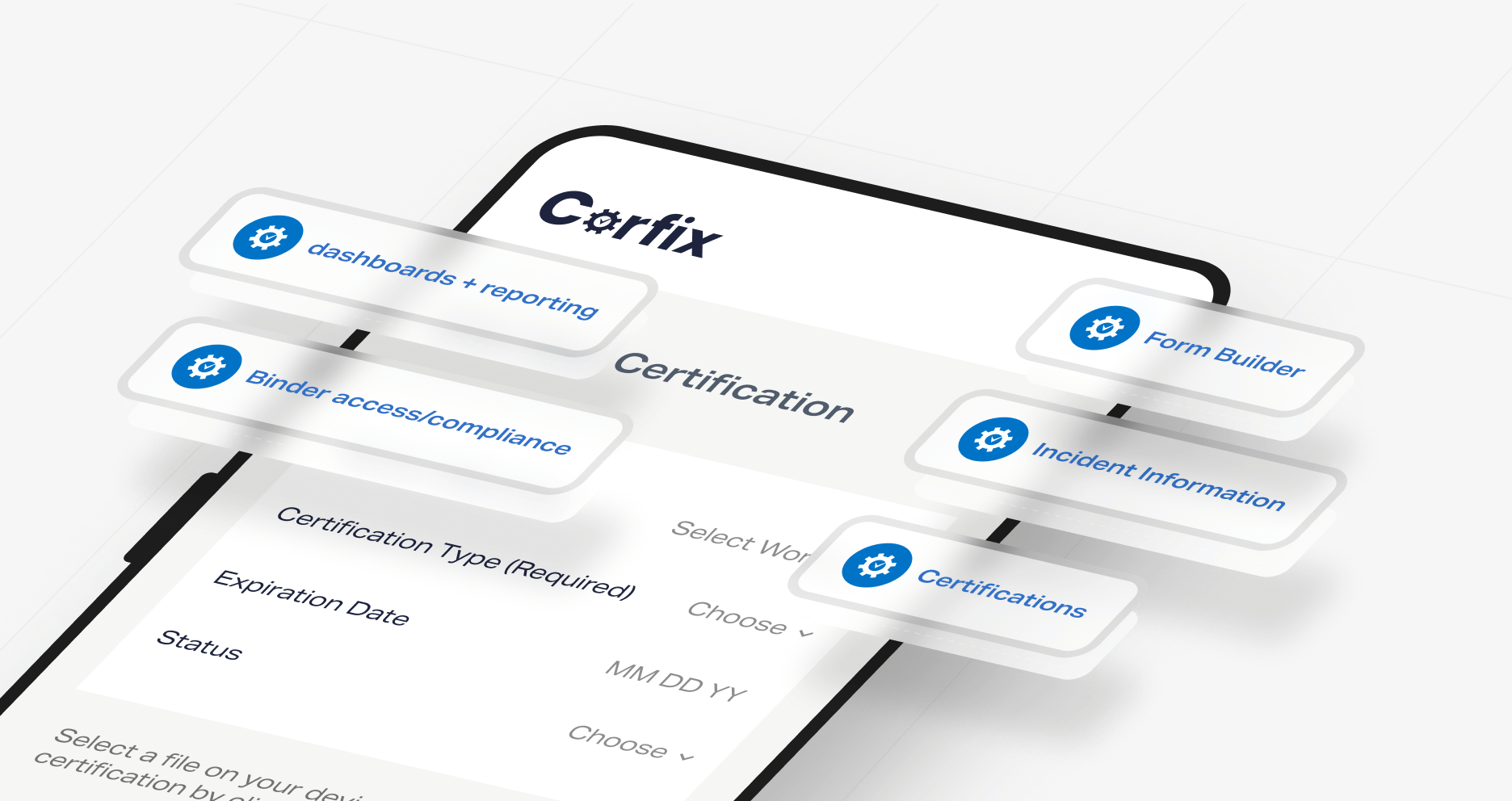
Corfix is a safety management and worker enablement platform for construction contractors.
Three calculations, one per module, each based on its own sources: 15 minutes a shift on safety paperwork and information, 2% of payroll on paid time that wasn’t worked, and one bad scheduling morning per crew per month plus half the scheduler’s week. For a 50-worker company using all three, Corfix’s conservative estimate is $155,618 a year, or about 6.2% of labour cost, with Safety alone at $77,448. It leaves out injuries, premiums, fines, rework and benefits, so every figure is lower than the real return.
It replaces paper safety forms, certification spreadsheets, whiteboard schedules, and jobsite records with one system crews fill in on their phones. It adds Timekeeping to the app if and when you choose that module, and keeps everything you need to track from the field in the same place. The return comes from costs you can already see in your own books: re-entry, chasing, audit preparation and idle time. It doesn't depend on a promise about injuries or premiums.

What is the ROI of construction safety software?: Cost Recovery
It’s the cost of running your safety program on paper, recovered. The credible case for safety software is rarely “it will prevent an injury” or “your premium will drop”; those outcomes depend on factors no vendor controls, and you should discount any proposal built on them. The defensible case starts with costs your company already pays and can measure: office time re-entering handwritten forms and timesheets, supervisors driving to collect paperwork, afternoons spent assembling records before an audit or a prequalification submission, and a worker sent home because a certification lapsed and nobody saw it coming.
It’s the hazard assessment filled in twice, the ten minutes finding the current drawing or the SDS, the wait for a foreman’s answer, the start time rounded back on a paper time card, the crew standing around because the scissor lift was never booked. Corfix captures the record once, on site, so that work stops being done twice, and it keeps the record retrievable so audit prep becomes a filter and an export.
How is the return calculated, module by module?:
| Module | What it counts | Rate | 50 workers, per year |
|---|---|---|---|
| Safety and Productivity | Time on paperwork, finding documents and waiting on answers | 15 minutes per worker per shift | $77,448 |
| Timekeeping Add-on module |
Payroll paid for time that wasn’t worked | 2% of payroll | $49,566 |
| Scheduling Included with Safety |
Crews waiting because the schedule was wrong on the day, plus the scheduler’s own time building and fixing it | 5 minutes per worker per shift, plus half of 4.5 hours a week per company | $28,604 |
| All three | $155,618 | ||
Safety and Productivity: 15 minutes per worker per shift. Digital forms, documents and instructions give each worker back 15 minutes a shift, or 65 hours a year, $1,549 per worker. In everyday terms: a worker on paper might spend five minutes on a hazard assessment at the start of the day, five minutes finding the current drawing or safety data sheet, and five minutes waiting for the foreman to answer a question. Every broad measure of lost time in construction is many times larger. FMI and PlanGrid’s 2018 study of nearly 600 construction leaders put non-productive work at more than 14 hours a week, 5.5 of them hunting for project information. Dodge Construction Network and Procore’s 2022 survey of 537 specialty contractors put low-productivity tasks like tracking down information or documenting on paper at 20% of workers’ time. Fifteen minutes is under a sixth of that.
Timekeeping: 2% of payroll. When every punch is real, timed and tied to a worker, the company stops paying for about 2% of hours that weren’t worked, $991 per worker a year. Two percent of an eight-hour shift is about ten minutes: a start time rounded back to 7:00 when the worker arrived at 7:10, a week of hours written up from memory on Friday, a coworker covering a late start. A QuickBooks Time survey of 242 accountants and bookkeepers put the cost of inaccurate time at 5% of gross payroll; Nucleus Research found ending buddy punching alone was worth 2.2%. Two percent sits below both. This line applies only if you add Timekeeping.
Scheduling: crew time on site plus the scheduler’s office time. Scheduling problems don’t happen every shift; they happen now and then and cost a lot each time. Averaged across every shift, Corfix counts five minutes per worker, $516 a year, which works out to about one bad morning per crew per month with the whole crew losing about two hours: the lift nobody booked, the schedule change that didn’t reach three workers, the double-booked worker, the crew waiting for someone who holds the working-at-heights certification. A 2025 University of Texas at Austin study found projects that planned crews, tools, equipment and information ahead lost 17 to 24 fewer minutes of each shift to delays; Corfix counts about 30% of the low end. In the office, Corfix customers polled in September 2026 spend an average of 4.5 hours a week building the schedule, sending it out and fixing it when something changes. Corfix counts half of that coming back, $2,788 a year per company at a labourer’s wage. Schedulers are usually supervisors or owners, so that understates it too.

What does a paper safety program cost that these figures don't price?: Compliance That Keeps Up With the Clock
More than the paper, and none of it shows up on an invoice. The three lines above count worker and scheduler time. Four more costs sit on top of them, and you can estimate each from your own operation.
Add these to the module figures and compare the total to a per-worker annual price.

Where does the return show up first?: Save Time
In the field, on the first day a crew fills in a form on a phone instead of a clipboard, and in the office within the first month. Forms arrive already organized by project, date and worker, so nobody types them a second time. Missing or incomplete forms are flagged the day they’re due. Certification expiry notifications go out ahead of time. Audit preparation becomes a filter and an export: one Ontario contractor went from three months of internal COR audit preparation to two weeks, and a Capterra reviewer who runs an HSE program described the change as freeing up hours of his time each week. Read what paper costs once a company scales.
- Re-entry eliminated at the point of capture
- Missing forms flagged the same day
- Audit and prequalification requests answered from an export
- Certification lapses caught before they idle a worker

What does it do for insurance premiums and WCB rates?: Risk + Compliance
It gives you the documentation those conversations run on, without promising the outcome. Experience ratings and premium reviews depend on your claims history and on your ability to demonstrate a functioning program. A complete, timestamped record of hazard assessments, inspections, training and closed corrective actions is what an insurer or a workers’ compensation board asks for, and it’s what defends a claim. Corfix produces that record as a by-product of the crew doing the work. Whether it moves your rate is between you and your carrier, which is why it isn’t in the figures above.

What does labour cost visibility look like with Timekeeping?: Labour Cost Control
Hours tied to a project and a worker, approved before they reach the payroll file, with about 2% of payroll no longer paid for time that wasn’t worked. Timekeeping is an add-on to Corfix Core. Workers clock in and out from the phone with GPS-enabled time cards, hours land against the right project, supervisors approve them, and the office exports for payroll instead of transcribing paper slips. For a controller that means labour cost by project without a spreadsheet, one fewer system to reconcile, and the 2% line above. A Capterra reviewer in a finance role describes quick access to punch data and location as what keeps her records accurate.

What does Corfix cost?: Predictable Pricing
A per-worker annual price for everyone in the system, plus an annual platform fee that covers onboarding, training and support. Scheduling is included in Core. Timekeeping is priced as an add-on module. Dashboards and reports are part of Core, not a separate line. There’s no charge per project and no charge per form; form volume and storage are unlimited, so the price is predictable against headcount. If you ask us to custom-build a large number of templates beyond what onboarding covers, that can carry a cost, and we’ll tell you before it does. See pricing or book a demo for a quote built on your worker count.

How do I build the business case?: ROI Assessment
Take the module figures for your headcount, add the four cost lines you can observe, and compare the total to a per-worker price.
- Run your worker count through the ROI calculator with only the modules you’d buy switched on.
- Count the forms your crews complete in a typical week, across all sites, and the office hours spent transcribing, filing, chasing and correcting them.
- Pull the days spent preparing for your last audit, inspection or prequalification.
- Count the certification lapses that idled or reassigned a worker in the last year.
- Add the cost of any tools you’d retire: form software, timesheet apps, document storage.
- Compare the total to Corfix’s per-worker price for your headcount.

Your return on investment
CFOs and Controllers: Frequently Asked Questions
One calculation per module, added together. Safety and Productivity counts 15 minutes per worker per shift given back on paperwork, finding documents and waiting on answers. Timekeeping counts 2% of payroll no longer paid for time that wasn’t worked. Scheduling counts five minutes per worker per shift on site plus half the scheduler’s 4.5 hours a week. All are priced at $23.83 an hour, the midpoint of Canadian and US median labourer wages, with no benefits included. Injury and premium reductions are left out because no vendor can promise them.
No software can promise that. Corfix gives you the complete, timestamped record that insurers and workers’ compensation boards ask for when your rating is reviewed, and the evidence that defends a claim. Whether that moves your rate is between you and your carrier.
Because a figure you can beat is more useful than one you have to explain. $23.83 is the labourer’s median, and labourers are the lowest-paid people on most sites. Your trades and supervisors earn more, and benefits add roughly 30% on top of wages in US construction. Both push the real figure above ours.
Per worker per year for everyone in the system, plus an annual platform fee that covers onboarding, training and support. Scheduling is included in Core; Timekeeping is an add-on module. Dashboards and reports are included in Core.
Onboarding and training are covered by the annual platform fee, and the Corfix Customer Success team rebuilds your existing forms during onboarding. Custom-building a large number of templates beyond that can carry a cost, which is quoted before the work starts.
No. Timekeeping captures and approves hours against projects and exports them for your payroll system.
The first return shows up in the field and the office within the first weeks: forms that no longer need re-entry and missing forms caught the same day. Audit-preparation time comes back at the next audit or prequalification cycle.